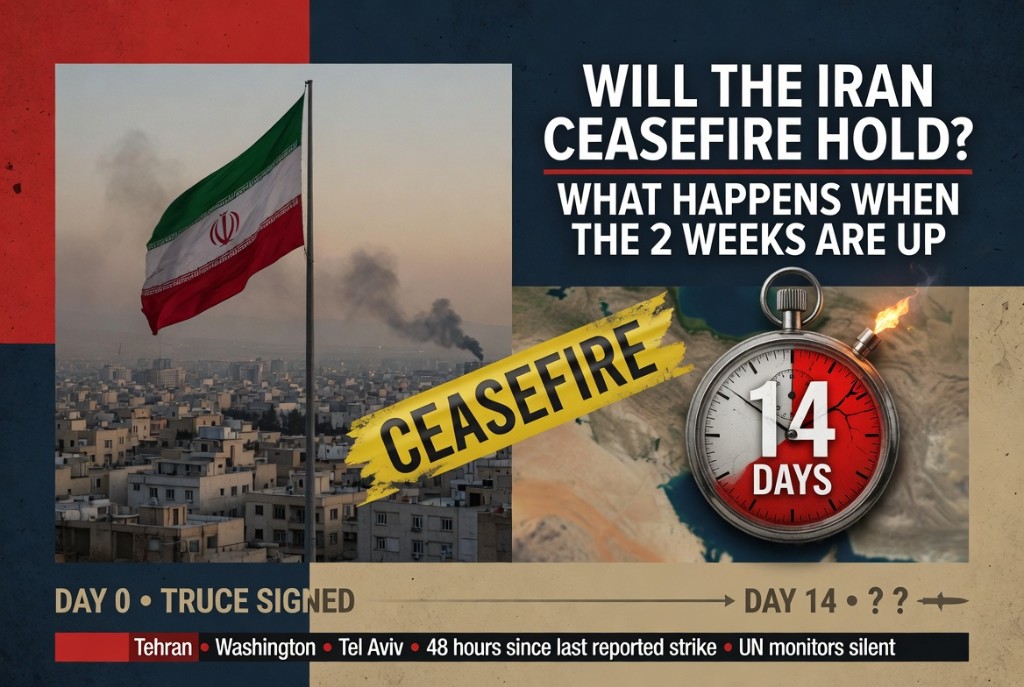
The guns have gone mostly quiet. But the Strait of Hormuz is still blocked, Lebanon is still burning, and both sides cannot even agree on what the ceasefire covers. The clock is ticking — here is what happens next.
What happened?
On the evening of April 7, 2026 — less than two hours before President Trump's deadline to destroy Iran's power plants and bridges — a ceasefire was announced. Pakistan brokered the deal. Trump posted it on Truth Social. Iran confirmed it shortly after.
After 38 days of war — after more than 13,000 U.S. and Israeli strikes on Iran, after Iran fired hundreds of missiles at Israel and U.S. bases across the Gulf, after the Strait of Hormuz was shut down and gas prices spiked 39%, after at least 3,400 Iranians and 13 American service members were killed — the shooting mostly stopped.
Mostly.
Because within hours of the ceasefire taking effect, Israel launched what it called its largest coordinated strike on Lebanon since the war began — more than 100 Hezbollah targets hit in just 10 minutes. Over 250 people were killed in Lebanon that day. Black smoke rose over Beirut during morning rush hour. Lebanon declared a national day of mourning.
And that is the problem. This ceasefire was broken before it even had a chance to breathe.
What the ceasefire actually says
Here is the deal in simple terms: the U.S. and Iran agreed to stop attacking each other for two weeks. Iran agreed to reopen the Strait of Hormuz. And both sides would use the two-week window to negotiate a permanent peace deal, using Iran's 10-point proposal and America's 15-point proposal as a starting point.
The talks would happen in Islamabad, Pakistan, with Pakistani Prime Minister Shehbaz Sharif mediating. Vice President JD Vance would lead the U.S. delegation. Special envoy Steve Witkoff and Jared Kushner are also reportedly involved.
That is the simple version. The complicated version? Nobody agrees on what the deal actually covers.
Five cracks that could break the ceasefire
The ceasefire is not just fragile — it is already showing major cracks. Here are the five biggest threats to the deal surviving its two-week window.
Crack #1: The Lebanon dispute
This is the single biggest threat to the ceasefire. Iran, Hezbollah, and Pakistan all say the ceasefire includes Lebanon. The U.S. and Israel say it does not. On the very first day, Israel bombed Beirut with the heaviest strikes of the entire war. Iran's IRGC warned of a "regretful response" if attacks on Lebanon do not stop. Hezbollah briefly paused its own attacks, then resumed rocket fire into northern Israel, saying it would keep shooting until Israel stops.
If this contradiction is not resolved, it could collapse the entire deal. Iran's president has called a ceasefire in Lebanon an "essential condition" for success.
Crack #2: The Strait of Hormuz is still blocked
The whole reason the ceasefire exists is because Trump threatened total destruction if Iran did not reopen the Strait of Hormuz — the narrow waterway where 20% of the world's oil normally flows. Iran said it would reopen it. But as of April 9, the strait remains effectively closed.
Only about four ships — carrying dry cargo, not oil — made it through on the first day. Iran is charging tolls reportedly over " million per ship and requiring all vessels to coordinate with its military. The UN estimates about 2,000 ships and 20,000 seafarers are stranded in the Persian Gulf, unable to pass.
The White House insists the strait is open. The data says otherwise.
Crack #3: Gulf states are still getting hit
On the first day of the ceasefire, Iran launched drone and missile attacks against Kuwait (28 attacks), the UAE (35 attacks), Qatar (7 intercepted), and Saudi Arabia (a pipeline hit directly). Iran said these were retaliation for strikes on Iranian oil facilities. A fire broke out at Abu Dhabi's Habshan gas complex. Iraqi-based Iranian proxy groups struck near Baghdad International Airport.
These are not minor incidents. They undermine the core premise of a ceasefire — that the shooting has stopped.
Crack #4: Nuclear uranium remains unresolved
This is the deepest and most dangerous fault line. Iran reportedly holds about 460 kilograms of 60% enriched uranium — enough raw material to potentially build roughly 11 nuclear weapons. The U.S. wants Iran to give up this stockpile and commit to zero enrichment. Iran demands its right to enrich be recognized as a non-negotiable point.
This issue caused negotiations to collapse before the war started, back in February. It is widely expected to be the hardest point to resolve in Islamabad.
Crack #5: Nobody trusts each other
Iran was attacked while it was in active negotiations with the U.S. in February. It happened again during the Twelve-Day War in 2025. Iran's hardliners point to this history and argue that any ceasefire is just a pause for America and Israel to regroup. Hossein Shariatmadari, a prominent conservative media figure in Iran, publicly argued that the U.S. "cannot be trusted" and that the ceasefire would be used to prepare for the next round of attacks.
On the other side, Trump said U.S. forces will remain deployed around Iran "until such time as the real agreement reached is fully complied with." He added: "If for any reason it is not... then the 'Shootin' Starts,' bigger and better and stronger than anyone has ever seen before."
Iran's 10-point plan vs. America's 15-point plan
These are the two documents that negotiators in Islamabad will try to bridge. They are far apart.
| Issue | Iran's 10-point plan | U.S. 15-point plan |
|---|---|---|
| Strait of Hormuz | Reopen under Iranian military control | Full, immediate, unconditional reopening |
| Nuclear program | Iran keeps right to enrich uranium | Zero enrichment; surrender stockpile |
| Sanctions | Remove all primary & secondary sanctions | Sanctions relief tied to compliance |
| Lebanon | War must stop on all fronts including Lebanon | Lebanon not included in ceasefire |
| U.S. military | Full withdrawal from the region | No mention of withdrawal |
| War damages | U.S. must pay compensation to Iran | No mention of compensation |
| UN resolutions | End all UNSC & IAEA resolutions on Iran | New IAEA verification regime |
| Non-aggression | Permanent U.S. guarantee of non-aggression | Not publicly stated |
Look at that table. On almost every major issue, the two sides want opposite things. That is why experts are not optimistic.
Ceasefire timeline: What has happened so far
What happens if the ceasefire fails?
Let's be blunt about what is at stake here.
If talks collapse and the ceasefire expires without a deal, Trump has explicitly promised to resume strikes — and to go further than before. Before the ceasefire, he threatened to destroy Iran's power plants, bridges, and civilian infrastructure. He used the phrase "a whole civilization will die tonight." Pope Leo XIV called that threat "truly unacceptable."
Iran, for its part, still has weapons. U.S. officials estimate Iran retains about half its missile launchers and half its drone fleet. Its new supreme leader, Mojtaba Khamenei, has publicly said Iran is studying "the opening of other fronts" where America is "highly vulnerable." The Houthis in Yemen could escalate. Hezbollah could expand operations. Iranian proxy groups in Iraq have already been active during the ceasefire.
And then there is oil. Gas prices in the U.S. are already up 39% since the war began, averaging $4.14 per gallon. If the strait stays closed, prices will go higher. The International Energy Agency has already released 400 million barrels from strategic reserves — the largest intervention in IEA history. That supply cushion will not last forever.
The global economy is watching this ceasefire like a patient on life support watches the heart monitor.
What happens if it succeeds?
The best-case scenario is that Islamabad produces a framework for a permanent deal: Iran gives up or downgrades its enriched uranium, the strait fully reopens, sanctions get a phased rollback, and the war ends. Oil prices crash. Markets surge. The U.S. pulls back its military posture.
Is this likely? Most experts say no — at least not in two weeks. The issues are too deep and the trust deficit is too wide. But a framework deal that extends the ceasefire while details get worked out? That is the realistic hope.
NPR's Mara Liasson offered a pragmatic take: she expects Trump will "make the concessions and claim total and complete victory. That's what he usually does." If gas prices drop fast, the political fallout may be manageable heading into midterm elections.
What this means for everyday people around the world
You do not have to live in Iran, Israel, or Lebanon for this ceasefire to affect your life. If you drive a car, buy groceries, heat your home, or have money in a retirement account, this war — and whether this ceasefire holds — matters to you directly.
At the gas pump and the grocery store: U.S. gas prices have jumped about 39% since the war started, hitting $4.14 per gallon on average; the spike has been worse in Europe and Asia. Oil also raises shipping costs for food, goods, and fertilizer — costs that show up at checkout, especially in lower-income countries.
In markets and jobs: Equities rallied and oil fell when the ceasefire was announced, but that is relief, not recovery. A collapse in talks could erase those gains. Disrupted Gulf shipping has slowed some Asian factories and stressed energy-importing economies.
For military families and civilians in the region: Thirteen U.S. service members have been killed; large deployments remain until Trump says Iran has complied. HRANA estimates more than 3,400 Iranians killed, including over 1,600 civilians; Lebanon has seen over 1,500 killed and 1.2 million displaced. Even now, Gulf states are intercepting missiles and drones. For many people, "ceasefire" does not yet mean "safe."
This is not a distant war. The Strait of Hormuz is a chokepoint for the global economy. When it closes, the world gets more expensive, more unstable, and more dangerous — whether you live in Tehran, Tel Aviv, Tokyo, or Texas.
Frequently asked questions
Sources
- Wikipedia — 2026 Iran war ceasefire
- Al Jazeera — US-Iran ceasefire deal: terms and what's next (Apr 8, 2026)
- CNN — Iran's 10-point plan and ceasefire terms (Apr 8, 2026)
- NPR — Latest on the ceasefire agreement (Apr 8, 2026)
- NPR — Fragile ceasefire shows cracks (Apr 8, 2026)
- NPR — Israel, Hezbollah, Lebanon talks (Apr 9, 2026)
- The National — Iran's 10-point peace plan (Apr 8, 2026)
- Jerusalem Post — Iran's 10-point plan (Apr 9, 2026)
- Euronews — Strait closure threat (Apr 9, 2026)
- UN News — Strait of Hormuz hopes (Apr 8, 2026)
- CNBC — Markets and fragile ceasefire (Apr 8, 2026)
- Gulf Business — Iran's 10-point proposal (Apr 7, 2026)
- European Council — Leaders' statement (Apr 8, 2026)
- CSIS — Latest analysis on the Iran war