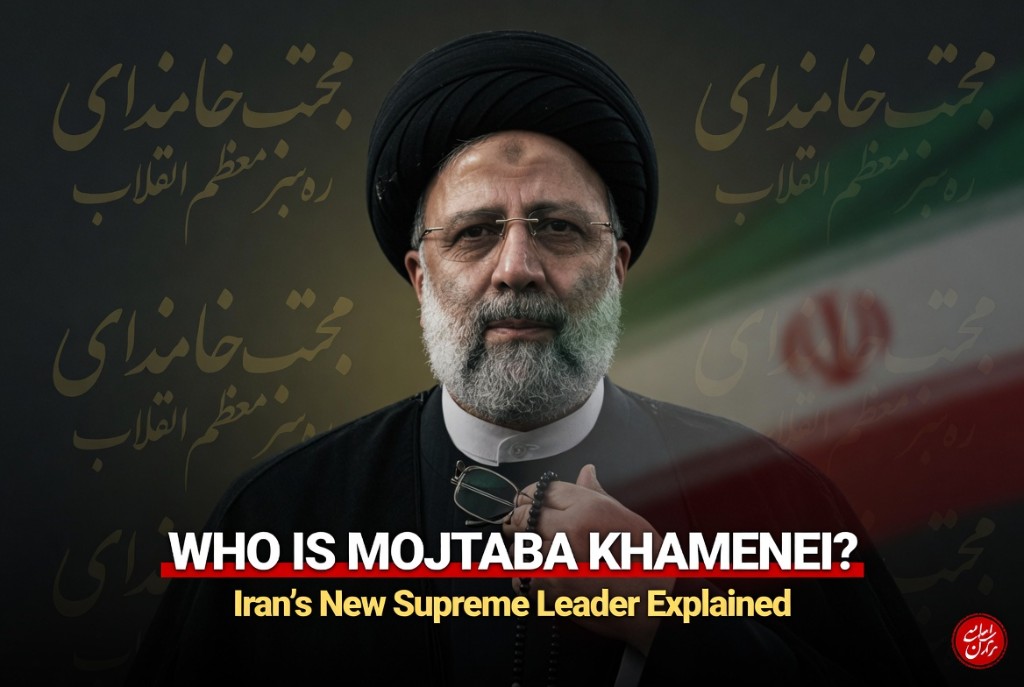
He never ran for office. He almost never spoke in public. For decades he worked from the shadows. Now Mojtaba Khamenei is the most powerful person in Iran — and he is steering the country through its largest war in a generation.
Quick profile: Mojtaba Khamenei
A leader no one elected
Before March 2026, most people outside of Iran had never heard the name Mojtaba Khamenei. That is exactly how he wanted it.
For decades, Mojtaba operated behind the scenes as one of the most powerful people in the Islamic Republic — but without any official government title. He never ran for parliament. He never served as a minister. He never appeared on state television. Instead, he quietly pulled strings from the shadows, using his father's authority and his own deep connections to Iran's military and intelligence services to shape the country's direction.
Now, at 56 years old, he is the supreme leader of a nation of over 90 million people — a country currently at war with the most powerful military on Earth.
How he rose to power
Mojtaba was born in 1969 in Mashhad, one of Iran's holiest cities. He was just 10 years old when the 1979 revolution overthrew the Shah and turned Iran into an Islamic Republic. His father, Ali Khamenei, was a key figure in that revolution and quickly rose through the ranks — serving as president and then becoming supreme leader in 1989.
Growing up as the supreme leader's son gave Mojtaba access to the most powerful circles in the country. He attended the elite Alavi High School in Tehran, then joined the Islamic Revolutionary Guard Corps (IRGC) during the final years of the Iran–Iraq War in the 1980s. He served in the IRGC's Habib Battalion, where he built relationships with officers who would later become Iran's top military and intelligence leaders.
After his military service, Mojtaba pursued religious studies and eventually became a hojatoleslam — a mid-ranking Shia Muslim cleric. That is one level below ayatollah, the rank his father held. This became a point of controversy: Iran's supreme leader is supposed to be a top religious authority. But his father also held the same lower rank when he took over in 1989, and the law was changed to accommodate him. Many expect a similar workaround for Mojtaba.
The shadow power broker
His influence did not come from a title on paper. It came from his role as his father's trusted enforcer.
The U.S. Treasury Department sanctioned Mojtaba in 2019, accusing him of representing the supreme leader in an official capacity despite never being elected or appointed to any government position. The Treasury said he worked closely with the IRGC commander and the Basij — a volunteer paramilitary force focused on suppressing political dissent inside Iran.
He is widely accused of engineering presidential elections. In 2005, reformist leaders in Iran blamed Mojtaba for working with the IRGC and religious leaders to ensure the election of the hardline candidate Mahmoud Ahmadinejad. When Ahmadinejad won a disputed reelection in 2009, triggering massive protests across Iran, Mojtaba was again accused of manipulating the results. During those protests, one of the chants heard on the streets of Tehran was a direct message to him: "Death to you Mojtaba, so you would never be the next leader!"
He is also connected to a hidden financial network. According to reporting by Bloomberg and Western media outlets, Mojtaba has amassed a large property empire stretching from the Middle East to Europe, though his name does not appear directly on any known transactions. He has been linked to Ali Ansari, a financier whose bank collapsed in Iran, worsening inflation and public anger.
How he became supreme leader
On February 28, 2026, the United States and Israel launched coordinated strikes that killed Ayatollah Ali Khamenei at his compound in Tehran. It was the opening phase of what became the 2026 Iran war. Mojtaba's mother, wife, sister, and brother-in-law were also killed in the same wave of attacks.
Reports about Mojtaba's own fate during the attack are conflicting. Israeli officials told Axios that he was present in the compound, was wounded, but survived. Al Jazeera reported that he was not present at all. What is clear is that nearly two weeks after the strike, when his first public message was delivered, he still had not appeared on video or audio. The message was instead read aloud by a news anchor on Iranian state television while a still photo of him was shown.
Iran's constitution gives the Assembly of Experts — an 88-member body of senior clerics — the job of selecting a new supreme leader. Normally this would be a careful, deliberate process. But wartime is not normal.
According to Iran International, the IRGC initially tried to install a new leader immediately after Ali Khamenei's death, bypassing the Assembly entirely. When that failed, IRGC commanders began pressuring Assembly members to vote for Mojtaba through what were described as "repeated contacts and psychological and political pressure." The Assembly held emergency online sessions starting March 3 — they could not meet in person because of security concerns, and their office in the holy city of Qom was reportedly bombed during one session.
On March 9, the Assembly announced that Mojtaba Khamenei had been selected as Iran's third supreme leader.
Why his appointment is controversial
The 1979 revolution was about one core idea: ending hereditary monarchy. Iranians overthrew the Shah — a king who inherited power from his father — in favor of a new order that rejected rule by bloodline. Now, 47 years later, the supreme leader's son has inherited his father's seat of absolute power. To many Iranians and outside observers, that looks a lot like a dynasty.
Ali Khamenei himself reportedly did not want this. In 2024, when the Assembly of Experts met to discuss his eventual succession, the elder Khamenei told them his son should be excluded from consideration, according to the New York Times. Shortly before the 2025 Twelve-Day War with Israel, he nominated three other senior clerics as potential successors in case of his assassination. None of them were Mojtaba.
But when the moment came, the IRGC — the institution most closely allied with Mojtaba — ensured that he got the job. Former Israeli Ambassador Michael Herzog told CNBC that the choice was an act of defiance: "The Iranians are showing defiance by choosing the son of Khamenei."
President Trump called the appointment a disappointment, telling Fox News: "I don't believe he can live in peace." He had previously dismissed Mojtaba as a "lightweight" and insisted the U.S. should have a say in choosing Iran's next leader — a demand Tehran rejected.
What he has said and done as leader
Mojtaba's first known public statement came on March 12, 2026 — nearly two weeks into the war. It was combative. In the message, he vowed revenge for every Iranian killed, said the Strait of Hormuz would continue to be used as a weapon, demanded that all U.S. military bases in the region be shut down or face attack, and praised Iran's proxy allies: Hezbollah in Lebanon, the Houthis in Yemen, and armed groups in Iraq.
He also hinted that Iran was studying "the opening of other fronts in which the enemy has little experience and is highly vulnerable" — a statement many interpreted as a threat to expand the war.
But behind the scenes, a different picture was emerging. According to Axios reporting from April 8, Khamenei had been actively involved in the ceasefire negotiations leading up to Trump's final deadline. Communicating through handwritten notes carried by runners — because of the constant threat of assassination by Israel — he gave his negotiators authorization to move toward a deal. Two sources described this as a "breakthrough." Iran's foreign minister, Abbas Araghchi, also played a central role in pushing IRGC commanders to accept the terms.
On April 7, the ceasefire was announced. Both sides claimed victory.
What does the supreme leader actually control?
If you are not familiar with how Iran's government works, here is the simple version: Iran has a president who is elected by the people, but the supreme leader has more power than the president. A lot more.
The supreme leader is the commander-in-chief of all armed forces, including the regular military and the IRGC. He has the final word on foreign policy, nuclear policy, and war and peace. He appoints the head of the judiciary. He controls state media. He can overrule the elected president on virtually anything.
The supreme leader is chosen by the Assembly of Experts and serves for life. He is not elected by the public. There are no term limits.
In short: Mojtaba Khamenei is now the single most important decision-maker in Iran. Whether the ceasefire holds, whether Iran gives up its enriched uranium, whether the Strait of Hormuz truly reopens — all of those decisions ultimately run through him.
Why the world should pay attention
The Islamabad peace talks are scheduled to begin today, April 10. Pakistan is mediating. Vice President JD Vance has been brought into the process, which analysts see as a sign that the U.S. is serious about avoiding a collapse in negotiations.
But the obstacles are enormous. Iran's enriched uranium stockpile — reportedly enough to build roughly 11 nuclear weapons — remains unresolved. The Strait of Hormuz is not fully reopened. Israel is still bombing Lebanon and says the ceasefire does not apply there. Iran says it does. Gulf states have been hit by Iranian attacks even during the ceasefire.
And at the center of all of it is a man who has never held public office, who communicates through handwritten notes passed by messengers, who may or may not be injured, and who has not been seen or heard in public since taking power.
Mojtaba Khamenei is among the most consequential figures in the Middle East right now. Much of the world is only now learning his name.
Frequently asked questions
Sources
- NPR — "Who is Mojtaba Khamenei, Iran's new supreme leader?" (Mar 9, 2026)
- Al Jazeera — Profile (Mar 9, 2026)
- CNBC — Five things to know (Mar 11, 2026)
- Axios — First message (Mar 12, 2026)
- Axios — Ceasefire reporting (Apr 8, 2026)
- Iran International — First message in writing (Mar 12, 2026)
- Times of Israel — Statement without appearing (Mar 12, 2026)
- Al Jazeera — First statement (Mar 12, 2026)
- Al Jazeera — World reacts (Mar 9, 2026)
- Wikipedia — 2026 Iranian supreme leader election