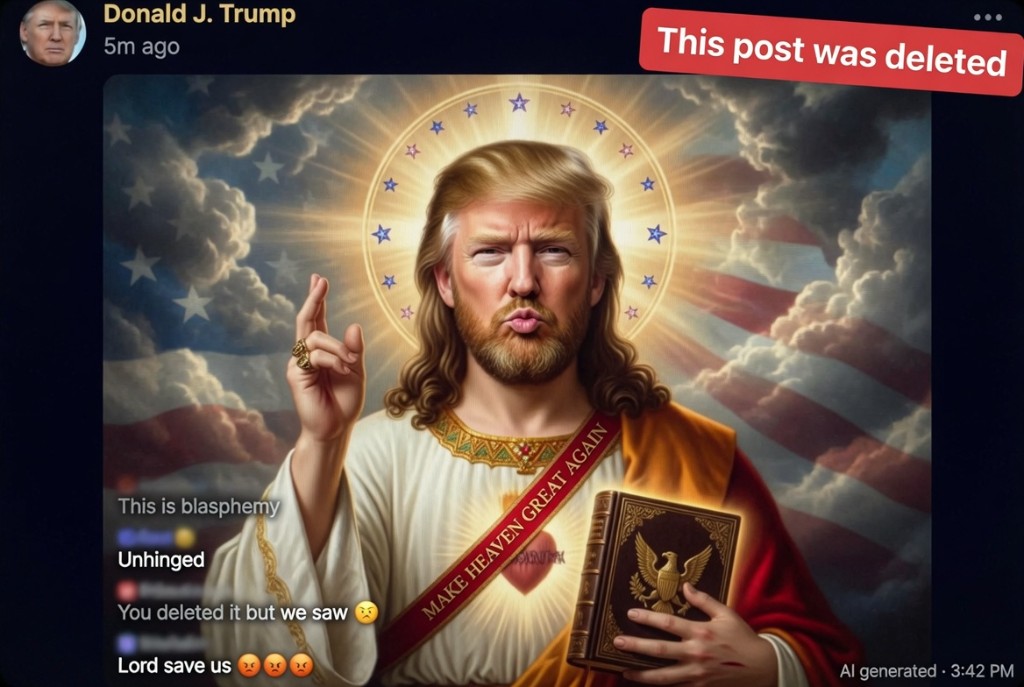
The president shared the image on Orthodox Easter — less than an hour after attacking Pope Leo XIV for opposing the Iran war. The backlash was swift, loud, and came from inside his own base.
President Donald Trump is facing one of the sharpest revolts from his own supporters in months. The cause is not a policy dispute or a legislative fight. It is a picture.
On Sunday night, April 12, Trump posted an AI-generated image to Truth Social. The image showed him wearing white and red robes in a style that looks like religious art. He is seen placing his hands on a sick man while light comes from his fingers. A soldier, a nurse, and other people watch. The sky above shows eagles and an American flag.
The meaning seemed clear to most viewers. The image looked like a painting of Jesus Christ healing the sick. And Trump posted it on Orthodox Easter, the holiest day on the calendar for millions of Christians around the world.
By Monday morning, the image was gone. But the damage was done.
What happened: a timeline
The backlash: his own base turns
What makes this moment different is where the criticism came from. It did not come from Democrats or liberal commentators. It came from Trump's own Christian base — the voters who helped put him in the White House.
Riley Gaines, a conservative activist who has been a key voice for the Trump administration on transgender athlete policies, wrote on X that she could not understand why he would post it. She said humility would serve him well and that "God shall not be mocked."
Former Rep. Marjorie Taylor Greene, who has grown more critical of Trump since leaving office, was even more direct. She said Trump was trying to replace Jesus and that she completely denounced it.
Conservative media figure Cam Higby called the image "blasphemy from the Oval Office." Gen Z commentator Brilyn Hollyhand posted a video saying that comparing yourself to Jesus, even jokingly, crosses a line that should not be crossed.
Trump's defense: "I thought it was me as a doctor"
On Monday, Trump spoke to reporters in what was described as an impromptu press conference outside the Oval Office. He said he thought the image showed him as a doctor, not as Jesus. He pointed to what he described as a Red Cross worker in the image, though no clear Red Cross imagery was visible.
When asked why he deleted the post, Trump told CBS News that he normally does not take posts down, but he did not want people to be confused. He did not apologize. This is not the first time Trump has posted an AI image that drew criticism from Christians. Weeks after Pope Francis died in 2025, Trump posted a fake image of himself as the pope.
The Iran war connection
This controversy does not exist in a vacuum. It is directly tied to the biggest story in global politics right now: the U.S.-Israel war with Iran, known as Operation Epic Fury.
Pope Leo XIV, the first American-born pope in history, has become one of the most prominent voices against the war. He has said God "does not listen to the prayers of those who wage war." He quoted the Old Testament book of Isaiah, saying that when people's "hands are full of blood," God will not hear their prayers.
Trump and his administration have taken the opposite position. Both Trump and Defense Secretary Pete Hegseth have invoked God to justify the conflict. When asked if he believes God approves of the U.S. actions in Iran, Trump said yes. Before a two-week ceasefire was reached, Trump threatened that "an entire civilization will die tonight" — words the pope called "truly unacceptable."
The Jesus image was posted less than an hour after Trump called the pope "WEAK on Crime" and said he didn't want a pope who criticizes the president. He also claimed the pope was only elected because he was American and accused him of catering to the radical left.
What this means for Americans
For American voters, this moment matters because it exposes growing cracks in a political coalition that has been central to Republican power for decades. Christian voters — especially white evangelicals and Catholics — helped elect Trump twice. But recent polling shows that support is softening.
| Religious group | Early 2025 | Early 2026 | Change |
|---|---|---|---|
| White evangelicals | 78% | 69% | ↓ 9 pts |
| White Catholics | 59% | 52% | ↓ 7 pts |
| White non-evangelical Protestants | 57% | 46% | ↓ 11 pts |
| Hispanic Catholics | 28% | 23% | ↓ 5 pts |
| Black Protestants | 14% | 12% | ↓ 2 pts |
| Religiously unaffiliated | 30% | 24% | ↓ 6 pts |
Source: Pew Research Center, survey of 8,512 U.S. adults, Jan. 20–26, 2026. Margin of error ±1.4 pts.
With 2026 midterm elections approaching, those numbers matter. Catholic voters in swing states like Pennsylvania, Wisconsin, and Michigan helped decide the 2024 presidential election. If even a small share of those voters move away from the GOP, it could reshape the midterm map.
The Jesus image episode could accelerate that shift. It is one thing to disagree with a president on policy. It is another to see him appear to compare himself to the central figure of your faith.
What this means for the world
On the global stage, the feud between the most powerful political leader in the world and the leader of 1.4 billion Catholics has consequences that go far beyond a single social media post.
Pope Leo XIV is now on an 11-day trip to Africa with stops in Algeria, Angola, Equatorial Guinea, and Cameroon. His visit to Algeria — a predominantly Muslim country — is the first papal visit there in history. It sends a message about interfaith dialogue and peace at a time when the U.S. is fighting a war that many in the Muslim world see as targeting their faith.
The Trump-Pope conflict gives other world leaders, especially in the Global South, a high-profile moral voice to rally behind if they oppose the Iran war. It also makes it harder for the U.S. to frame the conflict as a fight between good and evil when the leader of the largest Christian church on Earth is calling the war unjust.
| Dimension | Potential impact |
|---|---|
| U.S. diplomatic credibility | Weakened moral standing when the pope publicly opposes U.S. war justifications |
| Muslim world perception | Pope's Algeria visit signals interfaith solidarity; contrasts with war rhetoric |
| European allied support | Italian PM Meloni backed the pope; opposition leaders called Trump's attacks "extremely serious" |
| Ceasefire negotiations | Vatican peace advocacy could bolster the diplomatic track even as talks stall |
| 2026 U.S. midterm elections | Catholic voter erosion in swing states could shift congressional balance |
The bigger picture
This is not just about one image. It is about a pattern. Trump and his administration have used religious language to justify the Iran war. Defense Secretary Hegseth has framed military action as divinely supported and used scripture to back it up. Trump himself has said he believes God approves of the war.
Pope Leo XIV has pushed back against this at every turn. On Palm Sunday in March, he said God "does not listen to the prayers of those who wage war, but rejects them." On April 10, he wrote on social media that "God does not bless any conflict" and that no disciple of Christ is "on the side of those who drop bombs."
The Jesus image, whether Trump intended it that way or not, put a visual stamp on a debate that has been building for weeks: Who gets to speak for God in this war?
For Americans, that question touches the deepest part of their political identity. For the rest of the world, it shapes how the most powerful country on Earth is seen during a war that has already killed thousands and disrupted global energy markets.
The image is deleted. The debate is not.
Frequently asked questions
Sources
- CBS News — Trump faces backlash after posting AI image appearing to depict him like Jesus (Apr. 13, 2026)
- CNN — Trump deletes post depicting him as Jesus but refuses to apologize amid tension with pope (Apr. 13, 2026)
- Axios — Christians condemn Trump post depicting him as Jesus-like figure (Apr. 13, 2026)
- NPR — Pope Leo says he does not fear Trump, as he pushes back in feud over Iran war (Apr. 13, 2026)
- CNN — Pope says he has 'no fear of Trump administration' after president slams his Iran war criticism (Apr. 12, 2026)
- Time — Pope Leo responds to attack by Trump, saying he has 'no fear' of speaking out (Apr. 13, 2026)
- Pew Research Center — White evangelicals remain among Trump's strongest supporters, but less so than a year ago (Feb. 9, 2026)
- Newsweek — Donald Trump's approval rating flips with Christians (Mar. 2026)
- PRRI — Trump favorability declines among Republicans, some religious groups (Mar. 11, 2026)
- Euronews — Trump lambasts Pope Leo XIV in ongoing feud with Catholic Church leader over Iran war (Apr. 13, 2026)