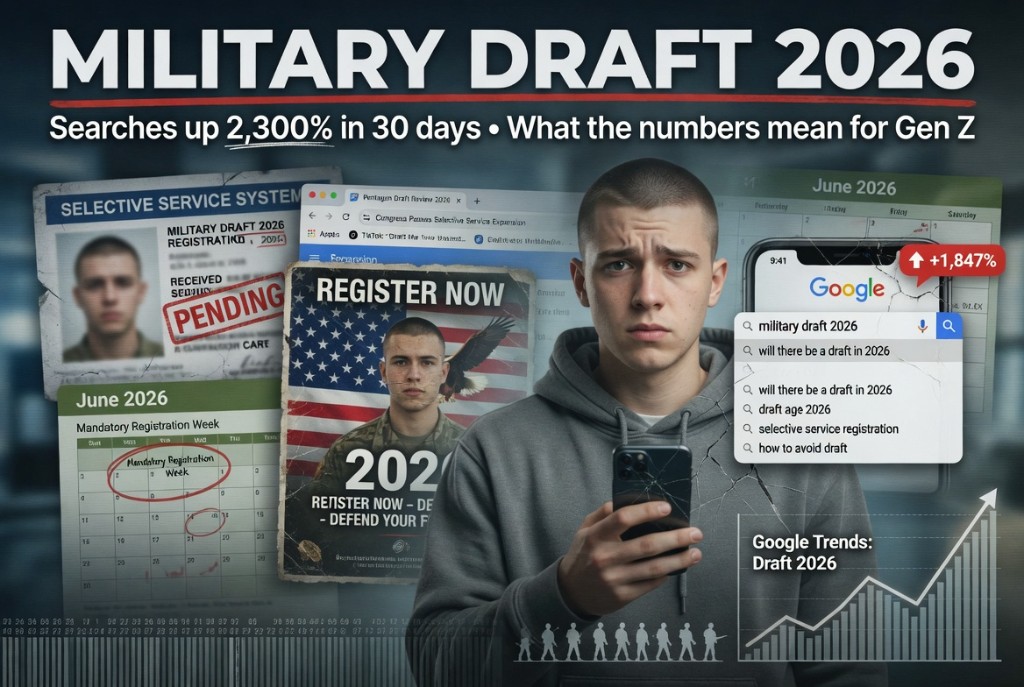
Automatic Selective Service registration, a fragile ceasefire with Iran, and a White House that will not rule anything out — here is why millions of Americans are suddenly searching for "military draft" and what it actually means.
What is happening right now?
If you have been online this week, you have probably seen people talking about the military draft. Two big things are happening at the same time, and together they are making a lot of people nervous.
First, the U.S. government announced that starting in December 2026, eligible men between the ages of 18 and 25 will be automatically registered for the Selective Service — the government agency that maintains a list in case a draft is ever authorized. Before this, young men had to sign up themselves.
Second, the United States is in the middle of a major conflict with Iran — Operation Epic Fury — and a fragile ceasefire just started on April 8, but nobody knows if it will hold.
When you combine a new registration rule with an active war, people get scared. That is why "military draft" is one of the most-searched terms in America right now.
What is the military draft?
The military draft — also called conscription — is when the government requires citizens to serve in the armed forces. The United States last drafted anyone in 1973, during the Vietnam War. Since then, the U.S. military has been all-volunteer.
What changed with Selective Service registration?
The Selective Service System keeps a list of men who could be called if a draft were ever activated. Being on the list does not mean you are going to war.
In December 2025, President Trump signed the fiscal year 2026 National Defense Authorization Act (NDAA), which includes a shift toward automatic registration using federal databases. On March 30, 2026, the Selective Service submitted its proposed rule; the target date for automatic registration to begin is December 18, 2026.
Why is the Iran war making people worry about a draft?
The U.S. and Israel launched coordinated strikes against Iran on February 28, 2026. After weeks of fighting, a two-week ceasefire was announced in early April, brokered with regional help. Both sides claim leverage; the situation on the ground and at sea remains tense.
So far, much of the fighting has involved air and naval power. If the ceasefire fails, if ground operations expand, or if the conflict spreads, the question of manpower becomes more serious — even though activating a draft would still require an act of Congress.
Can the president bring back the draft alone?
No. Activating a draft would require Congress to pass legislation. Both chambers would need to agree, and the president would need to sign. It is a high bar — politically and procedurally.
What does this mean for families?
If you are a young man between 18 and 25, or a parent of one, automatic registration (when implemented) means the government intends to place eligible men on the Selective Service list using federal records. That is not the same as being drafted.
Women are not required to register under current law. Penalties for failing to register (when self-registration was the norm) could include loss of certain federal benefits; under automatic registration, many of those concerns shrink because the process is handled administratively.
The bigger picture
Strait of Hormuz disruptions affect global energy prices. Allies and partners are watching U.S. decision-making closely. The draft debate is not only domestic — it is part of how the world reads American capacity and willingness to sustain a long conflict.
What could happen next?
Best case: ceasefire holds, shipping normalizes, and draft fears fade from headlines. Middle case: intermittent friction without a major new troop demand. Worst case: escalation that raises manpower questions — still separate from automatic registration, but emotionally linked in public debate.
The bottom line
The military draft is not active. What is new is automatic Selective Service registration — a congressional policy choice with a 2026 implementation timeline. The timing next to major war news is why search trends have spiked, even when the legal situations are different.
Frequently asked questions
Sources
- Military Times — Automatic registration reporting (Apr 8, 2026)
- The Hill — Automatic registration (Apr 9, 2026)
- Stars and Stripes — Automatic registration (Apr 7, 2026)
- Newsweek — U.S. military draft context (Apr 8, 2026)
- The White House — Operation Epic Fury release (Apr 8, 2026)
- NPR — Ceasefire coverage (Apr 8, 2026)
- Resisters.info — Selective Service legal context